
From Lab to Factory: China’s Embodied AI Robots Deliver Real-World Results
News 2026-06-09
In 2026, embodied AI robots have moved beyond exhibition showcases. They are now working on factory floors, in shopping malls, and at power stations, handling real production tasks. Over the past year, Chinese companies have achieved key breakthroughs in mass production, large-model deployment, and application scenarios – moving embodied AI from “hot concept” to “combat readiness.”
Mass Production & Deployment
At the end of 2025, STEP released the SYNDA R1, the industry’s first industrial‑grade embodied AI robot. With a humanoid design (1.78m tall, 2.05m arm span), 24 degrees of freedom, and sub‑millimeter precision, it features swappable batteries for 24/7 operation. Annual capacity has reached 10,000 units. More importantly, the R1 is already being validated in 163 Haier factories, handling handling, sorting, and assembly tasks in plants like Chongqing.
In February 2026, Dobot began the third batch of global deliveries of its full‑size industrial humanoid robot, ATOM. Powered by the self‑developed DOBOT‑VLA (Vision-Language-Action) model, ATOM translates natural language commands into executable tasks. It has been deployed at Shenzhen K11 cinema and other commercial sites, marking the first complete “production-delivery-application” closed loop for a Shenzhen robotics firm.
Technology Leap: AI Makes Robots Smarter
Traditional industrial robots require engineers to write line‑by‑line code. New‑generation embodied AI robots come with built‑in multimodal VLA models. A worker can simply say, “Move the bins from Area A to Area B, avoiding the middle pillar,” and the robot will recognise the environment, plan a path, and execute the task. Dobot, STEP, and others have already industrialised this capability, dramatically lowering the barrier to robot use.
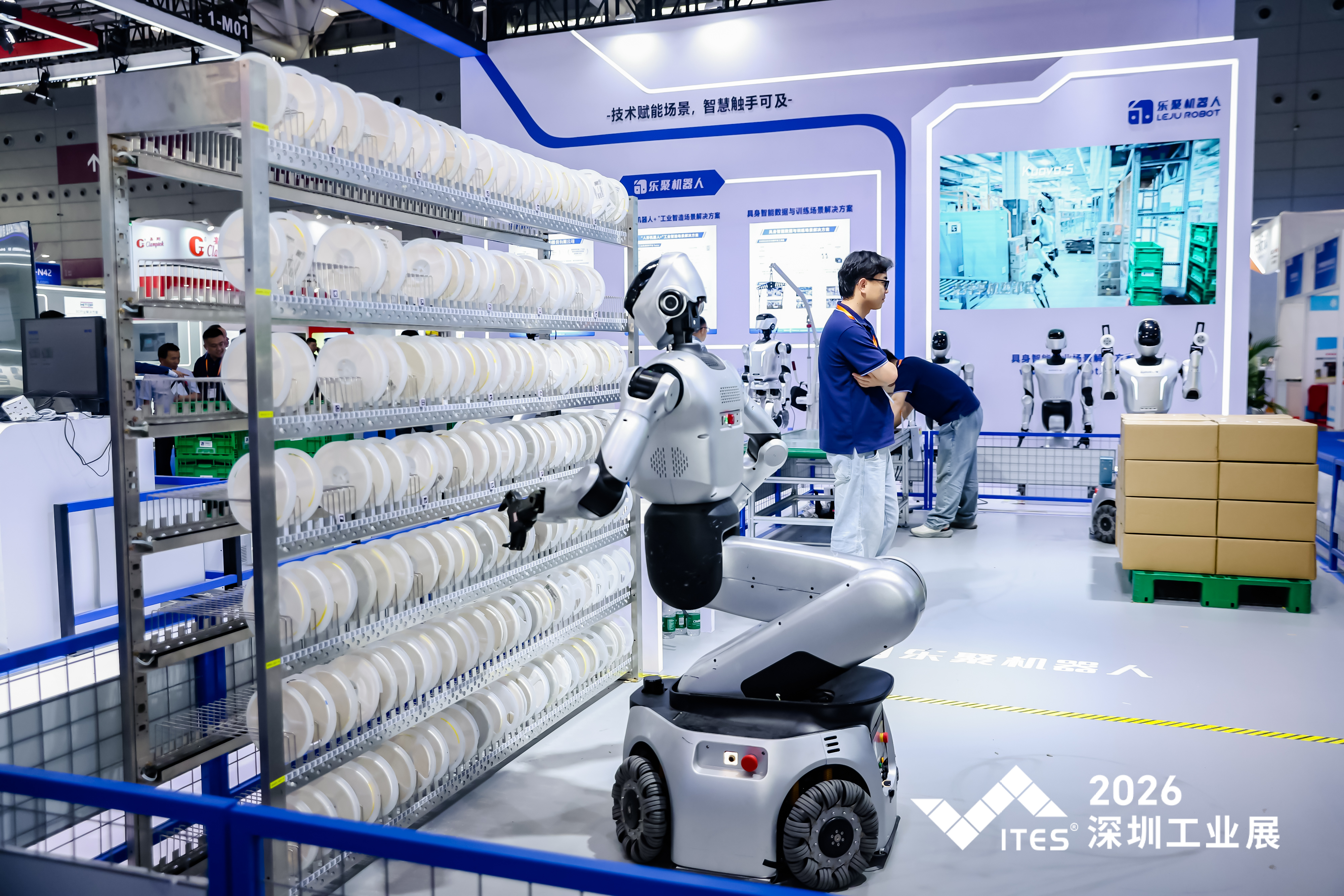
In motion control, Fanuc’s SMR‑300iA mobile composite robot (shown at ITES Shenzhen in March 2026) achieves dynamic obstacle‑avoidance picking with ±0.5mm accuracy, using SLAM navigation and 2.5D vision compensation. Domestic players like Flexiv and Roceso are advancing force control and flexible assembly, giving robots tactile sensing.
Diverse Scenarios: Quadruped Robots Join the Team
Application scenarios are expanding rapidly. In January 2026, Jingzhi Technology and Kaierda launched “Apollo,” an industrial quadruped robot developed with Zhejiang University. Apollo can climb 20cm steps, traverse rocky terrain, and is IP67‑rated. Its wheel‑legged version carries 70kg and runs for over 6 hours. It is already used for power grid inspection, high‑risk factory work, and emergency response.
From the Walker S2 on car assembly lines, to mobile composite robots in warehouses, to quadruped inspection robots at power stations – Chinese embodied AI products are penetrating every corner of industry. 2026 is shaping up to be the first year of large‑scale deployment for embodied AI robots, with Chinese companies taking a leading role in global competition.
 admin
admin